

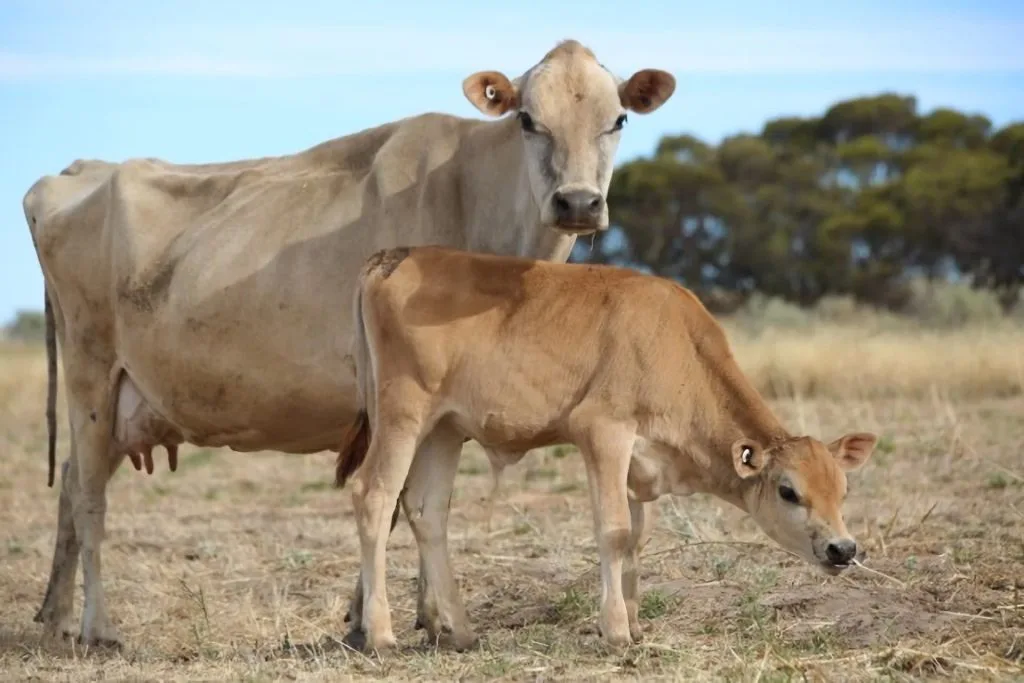

It’s one of the most common questions we hear at Freedom Hill Sanctuary, and surprisingly, many people don’t know the answer.
The simple answer is yes.
Just like humans, sheep, goats, dogs, cats and every other mammal, a cow must first give birth before she can produce milk. Milk is nature’s way of nourishing a mother’s baby. It isn’t something cows naturally produce all the time.
Yet this simple biological fact is often overlooked.
How Does a Cow Produce Milk?
A cow’s body begins preparing for milk production during pregnancy. Hormonal changes stimulate the development of her udder, and once her calf is born, milk production begins.
The calf’s suckling helps maintain that milk supply, although regular milking can also continue to stimulate production.
Over time, milk production naturally declines. To maintain high levels of milk production over many years, dairy cows are typically impregnated again after giving birth, beginning another cycle of pregnancy, birth and lactation.
This isn’t unique to cows—it’s simply how mammalian biology works.
What Happens in the Dairy Industry?
Because milk is produced for human consumption, management practices are designed around collecting that milk.
While practices can vary between farms and countries, in commercial dairy systems calves are commonly separated from their mothers shortly after birth. This allows the milk to be collected and sold rather than consumed by the calf.
Female calves may be raised to become the next generation of dairy cows.
Male calves, however, cannot produce milk and generally have limited economic value within dairy production. Depending on the farming system, they may be raised for beef or veal, or in some circumstances euthanised shortly after birth.
These realities are difficult to think about, but understanding them is an important part of understanding where dairy products come from.
Do Mother Cows Miss Their Calves?
Research and countless observations have shown that cows form strong maternal bonds with their calves.
A mother cow will often lick her newborn dry, encourage them to stand, call to them through gentle vocalisations and remain close while they nurse. Calves quickly learn to recognise their mother’s voice, smell and presence.
When they are separated, many cows continue calling and searching for their calves, sometimes for days. Calves also vocalise and seek their mothers.
These behaviours are widely recognised as signs of the strong bond that naturally develops between mother and baby.
The Mothers We Never Meet
When people think about dairy, they often picture green paddocks and contented cows.
What is less visible is that every drop of milk begins with the birth of a calf.
Behind every carton of milk is a mother who gave birth.
Behind every litre of milk is a calf.
Understanding this doesn’t mean judging people for the choices they’ve made. Many of us grew up believing cows simply produced milk because they were cows. We were never taught the biology behind it.
Education allows us to make informed decisions.
Why This Matters to Us
At Freedom Hill Sanctuary, we have welcomed calves who were considered to have little or no value within the industries they were born into.
When they arrive here, we don’t see commodities.
We see curious little personalities learning to trust.
We see frightened babies discovering safety for the first time.
We see individuals who love to play, who seek comfort, who form lifelong friendships and who simply want to be loved.
Every calf deserves the opportunity to know kindness.
Every mother deserves the chance to nurture her baby.
While we cannot change the beginning of every animal’s story, we can change the ending for those who find their way to Freedom Hill Sanctuary.
It is our hope that by understanding how milk is produced, people can make informed, compassionate choices—because knowledge is often the first step towards kindness.
Freedom Hill Sanctuary – Where Life Begins.